Aug 222012
 

I was informed yesterday that a bear has attacked our popcorn patch at the farm and cleaned us out.

Actually, the words Todd used were “It looks like a lawn mower went through it.  Right down to the ground.

When a coworker asked if he was sure it was a bear, Todd said that the critter “left evidence.”  (That means poop to those not familiar with bear “evidence”.)

So it looks like all Rick & I get from those 100 plants are these dozen little ears.

And some of those are less than full due to raccoons.

It has been a very challenging year for gardening.  If it ain’t the weather, it’s the critters.  And there’s not thing one you can do about it.

Except be thankful for what we did get.

And that I am.


Aug 202012
 

If you must go picking later in the day, drench yourself in bug juice because every mosquito in the state of Wisconsin lives in the blackberry patch you are working in.

Those.  Thorns.  HURT!!

Wear a long shirt, preferably made out of Kevlar to avoid being scratched to death by thorns.

I had an allergic reaction to 2 thorn scratches.  It was not pretty.  And it itched.  A LOT!

It took 2 weeks to heal from those 2 thorn scratches.  Antibiotic ointment and band-aids are my friend.

If you must reach for that last blackberry, make sure you don’t lean into the blackberry branch with the largest talons thorns.  You will regret it.

Thorns do fight back, especially when they have broken off and stuck into your pant leg.

If you are sick and tired of making blackberry jam, freeze the berries on a cookie sheet covered with plastic wrap.  You can break them apart when they are frozen and bag for later use.

Clean the debris from the blackberries before you rinse them, especially if someone had spilled some of their loot and scooped it off the ground in big handfuls bringing grass and leaves along with it forcing you to spend an extra 2 hours picking wet crap off of each wet berry.

Nibble on as many blackberries as you want while you are picking.  This is totally acceptable (and fun).

Don’t leave your berries on the counter overnight or your kitchen will smell like whine wine in the morning.

Every towel, wooden spoon and fingernail that comes into contact with the berry will be stained purple.

Watch out for bears.

Leave the last picking of the season to Mother Nature and the critters.  No need to be greedy.

Last, but not least, treat your husband to some homemade Blackberry muffins.  After all, he did get all those berries off the tall branches for you 🙂


Aug 162012
 

You can tell I’m a glutton for punishment when I spend 7 hours in the kitchen canning tomatoes and immediately head outside to start husking sweet corn.

What can I say… it needed to be done.

Isn’t that a glorious site?  All those sweet delicious kernels just begging to be added to my winter pantry (aka the garage attic).

Since I didn’t want to spend time on canning day husking these bad boys, I decided to do it the night before.  Now there are people that will poo poo this method, but as far as I’m concerned it doesn’t do any harm to the corn whatsoever (remember, I’m a canning rebel).  As long as the ears are in a covered container in the fridge, the moisture content of the corn isn’t diminished.

I’m tellin’ ya, working on that corn sure brought back a lot of memories.  When I was young husking corn was one of the summer chores us kids had to do.  Dad was a farmer, and one of his crops was sweet corn so whatever we needed, we got.  And as soon as that corn was ready in the field, it started making it’s way home to either be smothered-in-butter-corn-on-the-cob for supper, canned or frozen for winter use, or sold at our roadside stand.  When it wasn’t sold, us kids would all be perched on the garage stoop husking grain bags stuffed with sweet corn.

And Mom expected it to be clean, so you learned real quick how to pull those leaves back, parting the silk down the middle so you could take off as much with one pull and not have to spend any extra time picking stray strands off from between the rows.

We became professionals in no time flat.  All these years later, I quickly fell into that routine and had those 62 ears clean as a whistle in less than an hour.

Now there are two schools of thought on how to prepare the corn for canning:  blanch the ears in boiling water (approximately 3 minutes) and then cut the kernels off the cob, or just cut them off raw.  I opted for the blanching method.

Just like with the tomatoes, we’re going to give them a bath to get them all nice and clean.  I actually soak them for about 5 minutes to get any tiny worms that were hiding in the rows outta there (worms love corn).  This is also a good time to remove any kernels that may be a tad bit uggy.

I’ll also chop off any excess of the corn stem so that it will stand up better when I’m cutting off the kernels.

While they were getting sparkly clean, I got the water ready for blanching.  If you want to get the water boiling quick(er), put a lid on it.  All that heat stays in there to get the water up to temp faster.

I’ll blanch between 4 – 6 ears at a time, occasionally flipping them around to make sure that all the sides get heated.

With my sink free again, I fill ‘er up with cold water and ice cubes for a quick cool-down after their blanching (this sounds a lot like canning tomatoes, doesn’t it).

I’ll put my colander to use again to drain the corn after it comes out of the ice bath.  This way when I set them in the staging pot where they wait to be de-kerneled, the bottom row won’t be sitting in water for an extended period of time.  My corn is spoiled.

Quiz time:  Which ear has been blanched*?

OK now let’s make a mess!  If  you don’t have a fancy schmancy corn cutter (like I’m going to have next year), grab a nice sharp knife and start cutting downward on the ear.  You’re only gonna want to go about 2/3 of the way through the kernel and try to avoid cutting any of the cob.

Don’t get frustrated if you grab more or less on the first couple ears.  By time you’re done with your first dozen it will seem second hand to ya.

I took a break after I had enough corn to fill my first batch of jars.  The best size for Rick & I is 1/2 pint, so I’m gonna make as many of those as I can until I run out of jars then I’ll switch to pints.

This was also the perfect opportunity to use the 23 Quart pressure cooker I got from my girls a couple years ago.  I could double up the rows to fit 24 of these small jars in it.

Filling the jars is a cinch!  You want to fill the jars loosely with corn to within an inch of the top.  As with the tomatoes, I stopped at the bottom ring of the jar.  Since I had blanched the corn previously, I only had to boil up some water in the tea kettle and pour it over the corn.  I’m not going to use salt in these, but if you want to, go for it.

Since my stove is old as dirt, I had to position the canner over 2 burners to get enough heat under it.  When steam started coming out of the vent pipe, I set my timer for 10 minutes.  After that time was up, I set the pressure regulator on top of it and waited for the dial to come up to 11 pounds pressure as recommended by the canner instructions.

*Note:  I have 2 pressure canners with the other being 12 quart with a weighted gauge on it.  I’ll use that one on my second batch, which will be smaller.*

With my pressure in the canner up to 11 pounds, I set my timer for 55 minutes which is how long it takes to process corn in 1/2 pints and pints.  It is important to adjust the heat of your burner to keep the pressure as consistent as possible.

When the timer goes off, shut your burner off and wait for the pressure to come down to normal before removing the lid.  This monster pot was heavy, so I lifted it off the stove (praying I didn’t get a hernia) and set it on the rug on the floor.  Getting it away from the original heat source (which was still hot) helps it to cool down a little quicker.

My original plan was to immediately get my other canner filled and going to shave some time off my stint in the kitchen, but I had forgotten that I had to use the cooking rack from the smaller unit to make my second tier on the first go-round.

Best laid plans…

When the pressure was back to normal on the first canner, I could get the jars out (with the jar lifting tongs, of course) and set them on their towels to cool and seal.  It didn’t take long for the popping music begin!

My 5+ dozen ears of corn yielded 31 half pints and 2 pints of corn.  I’m more than happy with that yield.

Using a pressure canner can be a little scary the first time you use them, because there are a few more things you have to be aware of and watch than the simple water bath.  But for low acidic vegetables, it is the only way to heat it to the proper temperature to kill any bacteria from forming to spoil your food.

Always make sure that you do your research on how to can your produce, from which equipment to use to processing times.  Once you have become comfortable with the basics, start looking at all the other things that can be preserved:  meat, stews, broth… the possibilities are endless!

The nice thing about preserving your own food is you get to control what you are putting into your body.  What you’re eating isn’t full of preservatives and you’re not paying some big corporate entity for your food.

Sure, it takes some time, but once you start opening those jars and taste real food, you’ll wonder why you didn’t start doing it sooner.


* The one on the left.  See that wonderful shine it has?  Actually, you can probably eat it at this point.  (I snacked on a few kernels as I was cutting them off.  Don’t tell anybody.)


Aug 142012
 

I’ve been a busy homesteader the last few days.  Even though it seems awful early for harvesting, it does make sense considering the early spring/summer that we had.

And as they say in the farming biz, make hay while the sun shines!

Well, I’m not a farmer, but the same rules apply when canning all the goodness that is coming to us right now.

I was originally intending to give you the post on Phase Two of my canning today, but I simply haven’t found the time or energy to edit and upload the pictures (you gain a reprieve today I guess).

Instead I want to share this

I don’t know what it is about this photo, but I love it dearly.  This was taken at the family farm and the light was just so perfect with the dying weeds all around this old milk can.  I imagine I lugged this old jug around a time or two when I was younger.  Even empty those things weigh a ton.

Please bear with me for the next few days as I work my way through the blackberry patch (again) and another 25 pounds of tomatoes.

Uffda!


Aug 132012
 

I’ve whined, sniveled and complained enough this summer about how the blight ruined the tomato plants that I started from seed and nurtured in my greenhouse until it was time to go in the garden.

Rick felt bad for me, too.  My goal was to can enough tomatoes so that I wouldn’t have to buy any this winter.  I put an order in with Todd at the farm for a bushel, but those aren’t ready yet.  Then Rick came home on Saturday with this

Aren’t they beautiful!!  There was a roadside stand in town that was selling organic (YAY !!) vegetables and he decided to lift my spirits by purchasing 25 pounds of tomatoes and 4 dozen ears of corn (corn was another item that I didn’t want to buy this winter either).

I was in canner’s heaven.

Sunday morning was the start of phase one:  Canning tomatoes.  Mind you, I’m a canning rebel, which means I don’t do anything the easy way.  And the easy way would have been just to peel the tomatoes and cold pack them for canning (cold pack is just quartering them and packing them in jars).

Naw… easy way out.  Besides, I’m not a fan of all the liquid that settles at the bottom of the jars when you do it this way.  It basically looks like you have a half a jar of usable product, or you have to add tomato paste in order to get a sauce consistency.

Nope, ain’t gonna do it.

Instead, I’ll spend 7 hours in the kitchen peeling, cutting, squishing, cutting, squishing again, and cooking the tomatoes to get a great jar of tomatoes that will taste oh-so-wonderful in the middle of winter.

So, if you’ve never canned tomatoes before, you’ve come to the right place today to learn.  If you are an expert at canning tomatoes… well, I’ve got nothing for you today.  Thank you for stopping by and come back soon, ‘k?

Alrighty then, let’s start off by getting those ‘maters nice and clean.  Even though you’re going to be peeling them, you don’t want any unwanted dirt or bugs in your end product.

The easiest way to peal these bad boys is to blanch them in boiling water.  (There are other ways, but we’ll go with easiest today.)  This will take no more than 1 minute to do once you place the tomatoes in the water.  Any longer, and you are basically cooking that poor thing in it’s own skin.

Get your (clean) sink full of ice water for the cooling off period.  We want to stop any further cooking action at this point. Now don’t let them sit in that water for too long, because if you do you run another risk of the tomatoes getting soggy (they’re made up of enough water the way it is).   A couple minutes is plenty.

*Random fact:  Did you know that tomatoes can be up to 95 percent water?  That’s more than watermelon!*

See how nice the skin has started to peel back from the meat?  Beautiful!

Cut out the core and any owies/booboos it may have and let that skin just slip away.  A paring knife is all you need to get the action going.  A good time saver:  quarter the fruit right after you’ve peeled them.  If you wait until they’re all skinned, you’re adding another step (totally up to you).

Now here is where I get a little anal about canning tomatoes.  I’m gonna take all these wedges and squeeze as much liquid out of them as possible.  My strainer in the sink is going to catch any seeds and juice (and any errant tomatoes that slip through my fingers).

Then I take those once plump quarters and cut them into small pieces.  Before I toss them into another pan, I’m gonna squeeze them again, removing yet more of the liquid.

You know you’ve been successful in squeezing out the liquid when you find that you have tomato seeds/liquid/meat all over your counter/windows/clothes/hair/cat.  Bonus points for hitting the wall 5 feet away (that is talent right there!).

When you’re done with the peeling, cutting, squeezing, etc, etc, you get a nice looking batch of tomatoes.  Now, if I was making salsa, this is where I would add my peppers, onions, and other ingredients.  But since I’m not making salsa (this time), I’m just gonna take this pot over to the stove and heat it up.  This is also the time that I will start the water to boil in my water bath canner*.

Since the tomatoes are in nice small shapes, they are easier to break down in the boiling process.  This will insure that I don’t have all of that water/liquid in the bottom of my jar when they are done in the canner.
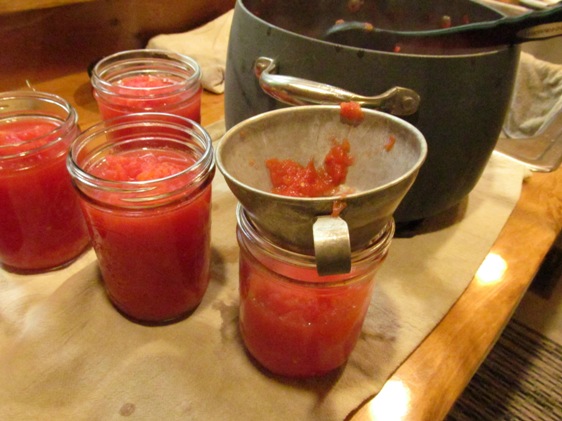
I’ll cook the tomatoes until the water in my canner has reached a boil, and then I’ll fill my jars.  I stop at the bottom ring of the jar, which is about an inch.

Then I’ll add 1/2 teaspoon of salt.  Rebel canner alert:  I have never added lemon juice or citric acid to my canned tomatoes (as recommended by “the experts”).  Back in the day (when I learned how to can from my Mama), a little bit of salt was all that was needed as a preservative.  I could go into the why’s and wherefore’s for my reasoning to not add those other things, but that can be another post all of it’s own.  Besides, no one has ever gotten sick from my canning, so that there is proof enough that the method works.

If you want to add those other things, that is completely fine.  We each have our own methods and what we feel safe with, so please don’t blast me for mine.

Thank you.

Alrighty then, let’s get these babies in the canner!  You want at least 2 inches of water covering the jars after you have set them into the canner.  Put the lid back on and boil 35 minutes for pints, 45 minutes for quarts.  These times are based on my altitude (sea level), so if you live higher up in the hills, do a Google search for times based on your location.

When the timer goes off, lift them out of their bath with a jar lifter (a must-have for any canner) and set them on a dry towel to cool.  When you start hearing that “pop” “pop” “pop” sound, do a little happy dance because those puppies are singing that beautiful song of sealing.

After 12 hours, remove the bands and make sure that each of the lids has a tight seal (depressed lid).

Store and enjoy!

And if you’re wondering how much I got out of those 25 pounds?

Just over 12 pints.  Now this might not seem like much to you, but considering that it’s just Rick & I, that gets us about half way through the winter.  I’m planning on picking up some more the next time I’m in town, and when I get my order from the farm (crosses fingers) I’ll use that for salsa.

Again, this method is very time consuming, but for me the end result makes it all worth while.  And if I can enlist Rick’s help, I can cut that time in half.

Our next adventure will be canning sweet corn.  Aren’t you excited?!?


* You can also use a pressure canner when doing tomatoes.  The PH level in the fruit is so close to the cut off point for acidity that either option will work.